

Free printable habit tracker: one habit, one X a day
Download a free November 2026 habit tracker PDF in A4 or US Letter. No sign-up. Pick one small habit, print your calendar, and mark each day.
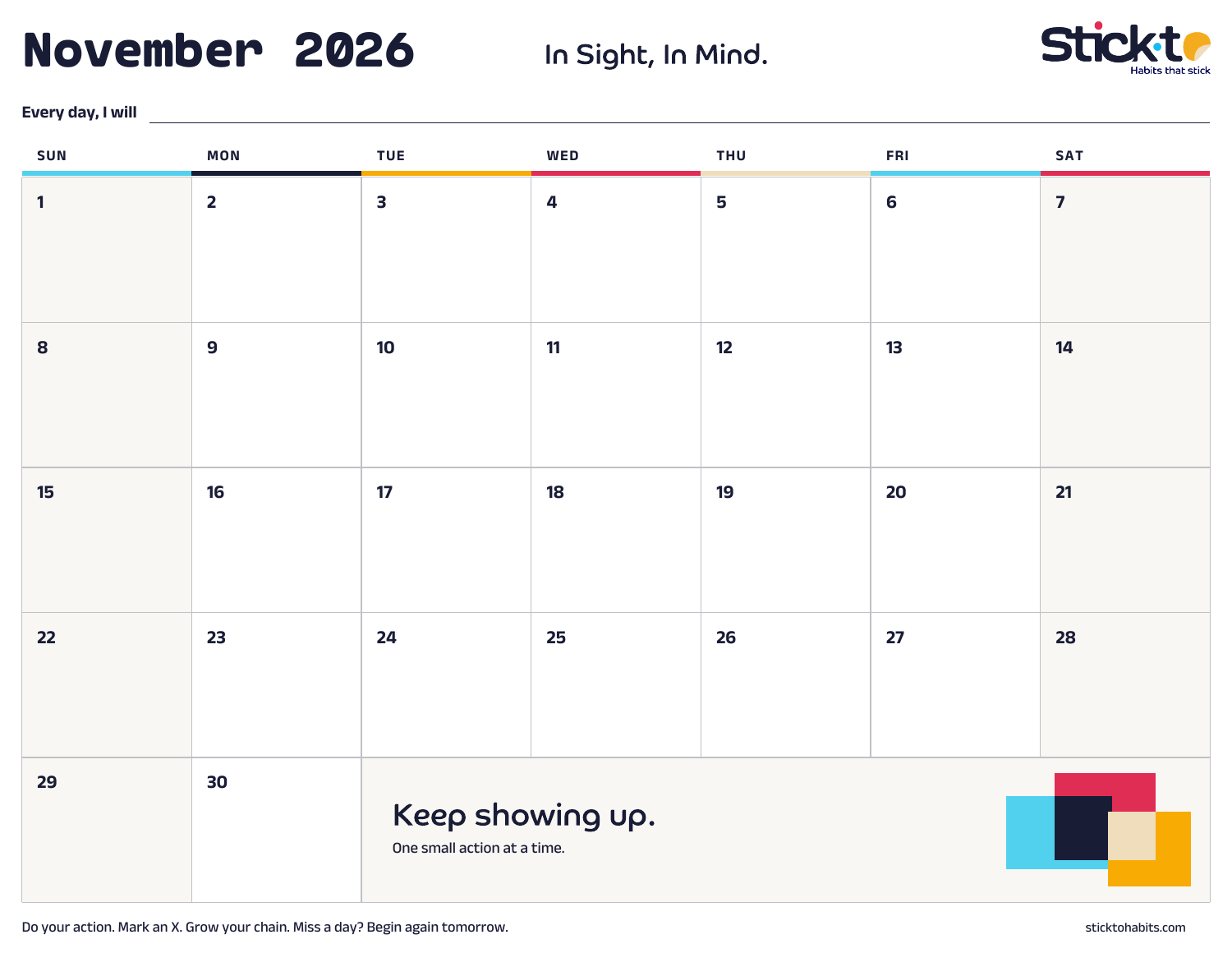
A printable habit tracker can be as simple as a one-page monthly calendar. You write one habit at the top, put the page somewhere you'll see it every day, and draw an X on each day you do the habit. You don't need a grid of ten habits or an app to start. One habit, kept small, tracked on paper is enough. That's how I started, and it's still what I'd tell a friend. Download the November 2026 calendar below, in A4 or US Letter. Then pick one small habit and make your first X.
Download your free habit tracker
Choose your paper size for November 2026. Free PDFs, no sign-up.
A fresh calendar. A small reason to keep going.
I’ll email you a free printable calendar at the start of each month, in A4 and US Letter. Print it, pick your habit, and keep showing up.
Form: Your email address. Button: Send me the monthly calendar.
Optional, unchecked checkbox: Yes, I’d love occasional Stickto updates, too.
A little news about what we’re making and what’s coming next. Totally optional.
One calendar email a month, plus occasional updates only if you choose them. No spam. We’ll never sell your email address. Unsubscribe anytime. Privacy policy.
Why track just one habit?
Most habit tracker printables you'll find online are grids with eight, ten or fifteen rows. They look great. They're also a lot to keep up with if you're new to this, and when you fall behind on several habits at once, it's easy to give up on all of them.
I first heard about this approach through a story about Jerry Seinfeld: write jokes every day and mark an X on a calendar each day you do it. The growing chain gives you a reason to come back tomorrow. That story, shared by Brad Isaac on Lifehacker, made the idea feel simple enough to try.
I started with something much smaller. In 2016, I made a deal with myself: before I could call it a bad day, I had to give one good thing a try. For me, that was five minutes of writing.
Some days I only did five. Other days I did fifteen. Some days I'd end up writing for an hour. But five minutes was all I had agreed to. Eventually that rolled into a few more habits: five minutes each of writing, meditation and working out. Then I'd X out the day on my calendar.
I didn't do it perfectly. Sometimes I'd ignore that calendar for weeks, even a month or two. But it stayed on the wall, and eventually I'd see it again and think:
“Okay. I’ll start this again.”
Coming back slowly became a habit of its own. That's a big part of why I made Stickto.
Starting with one habit means:
-
One decision a day. Did I do it or not? There's nothing to sort or prioritize.
-
A clear picture. Your calendar shows the days you showed up, without a dozen habits competing for attention.
-
Room to grow. Once the first habit feels automatic, you can add a second one and keep the first.
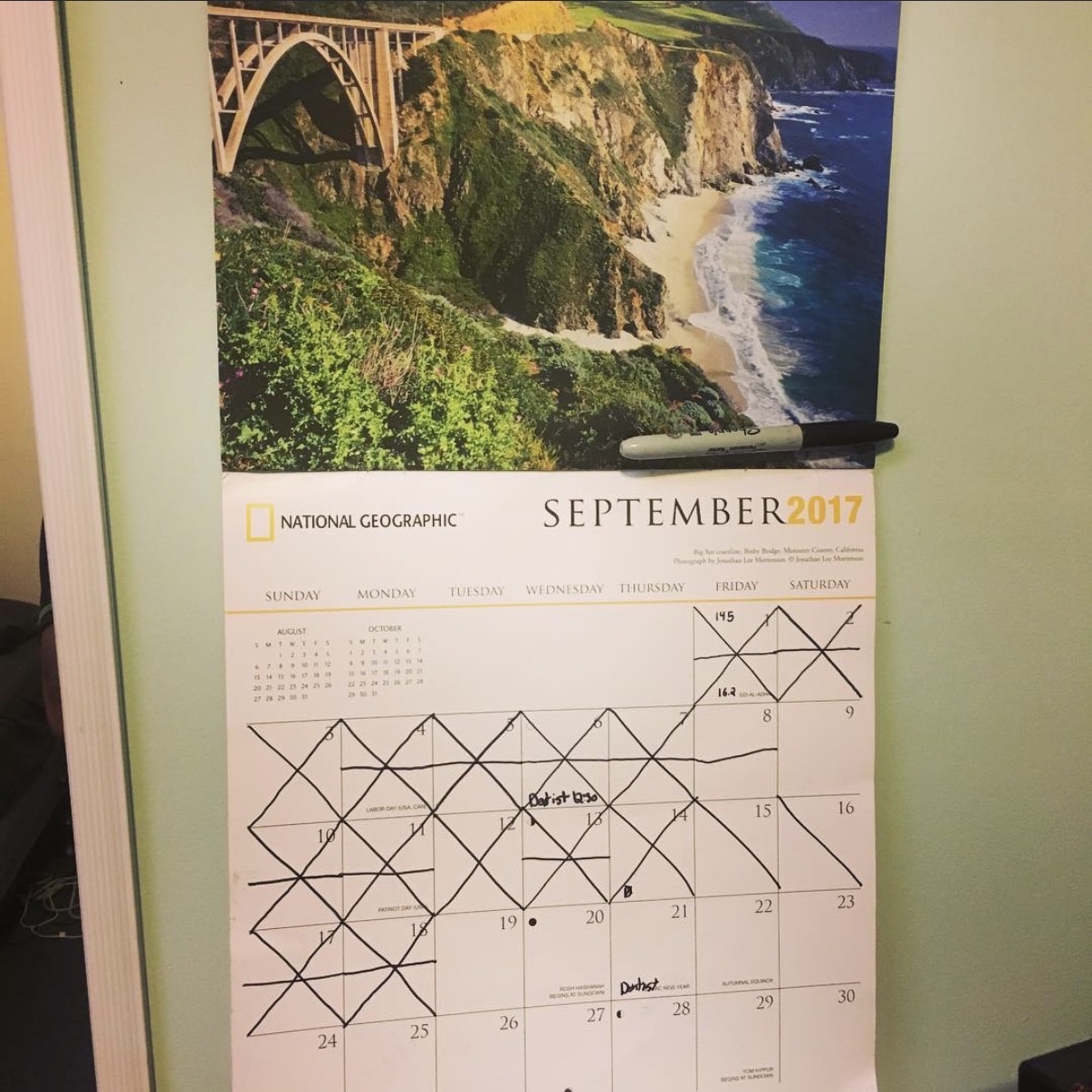
My calendar in September 2017. A wall calendar, a marker, and a record of showing up.
What the research says about tracking habits
You don't need science to X out a calendar. I didn't know any of this when I started. But the research behind it is encouraging.
Writing your progress down helps. A 2016 meta-analysis in Psychological Bulletin pooled 138 experimental studies with nearly 20,000 participants. It found that interventions that got people to monitor their progress helped them reach their goals. The effect was larger when people physically recorded their progress and when they reported it or made it public. (Harkin et al., 2016)
There isn’t a universal 21-day rule. In a well-known University College London study, 96 volunteers picked a daily eating, drinking or activity habit and did it in the same context (for example, "after breakfast") for 12 weeks. For participants whose data fit the model well, the estimated median time to reach 95% of their eventual automaticity was 66 days, with estimates ranging from 18 to 254 days. Some estimates extended beyond the 12-week observation period; this is not a deadline for your habit. (Lally et al., European Journal of Social Psychology, 2010)
Missing a day doesn't ruin it. The same study found that missing one opportunity to do the behavior "did not materially affect the habit formation process." That's the spirit of the reminder on the calendar: begin again tomorrow. You don't need a perfect streak. I definitely didn't have one. (Lally et al., 2010)
Consistent context matters. Participants in that study tied their habit to the same moment each day. Doing your habit at the same time, or right after something you already do, gives it something to attach to.
How to use a one-habit printable calendar
-
Pick one habit. Choose something you want more of in your life, not something you feel you should do.
-
Make it small. Shrink it until you could do it on a bad day: five minutes of writing, one glass of water before coffee, two pages of a book, a 10-minute walk.
-
Anchor it to a moment. Decide when and where, for example "after I pour my morning coffee" or "when I get home from work."
-
Write it on the “Every day, I will” line. Be specific: "5 min journaling after coffee" is better than "journal more."
-
Put the calendar where you'll see it. The fridge, the bathroom mirror, next to your desk. For me, the calendar on the wall was the reminder, even on the days I wasn't ready to listen to it.
-
Mark an X when you've done it. Do it right away so it doesn't become a second task you forget.
-
If you miss a day, leave it blank. No catching up, no starting over. Just mark the next day you do it.
-
At the end of the month, look back. Count your X's, notice what helped, and print next month's page.
What counts as a "small enough" habit?
A good test: could you do it on your worst day this month? If not, shrink it. Mine was five minutes of writing, and some days even that felt like a lot. Here are a few one-habit ideas that fit in a calendar box:
-
Move: a 10-minute walk, or 10 push-ups
-
Read: two pages
-
Calm: five minutes of meditation or breathing
-
Hydrate: a full glass of water first thing in the morning
-
Write: five minutes of journaling or one line of gratitude
-
Rise: out of bed at your target time
-
Unplug: no phone for the first 30 minutes of the day
When should you add a second habit?
There's no exact rule. Since the research above shows habits can take weeks or months to feel automatic, a good rule of thumb is to wait until the first habit feels easy, the kind of thing you'd do even without the calendar. Then print a second calendar for your next habit, and keep the first habit going.
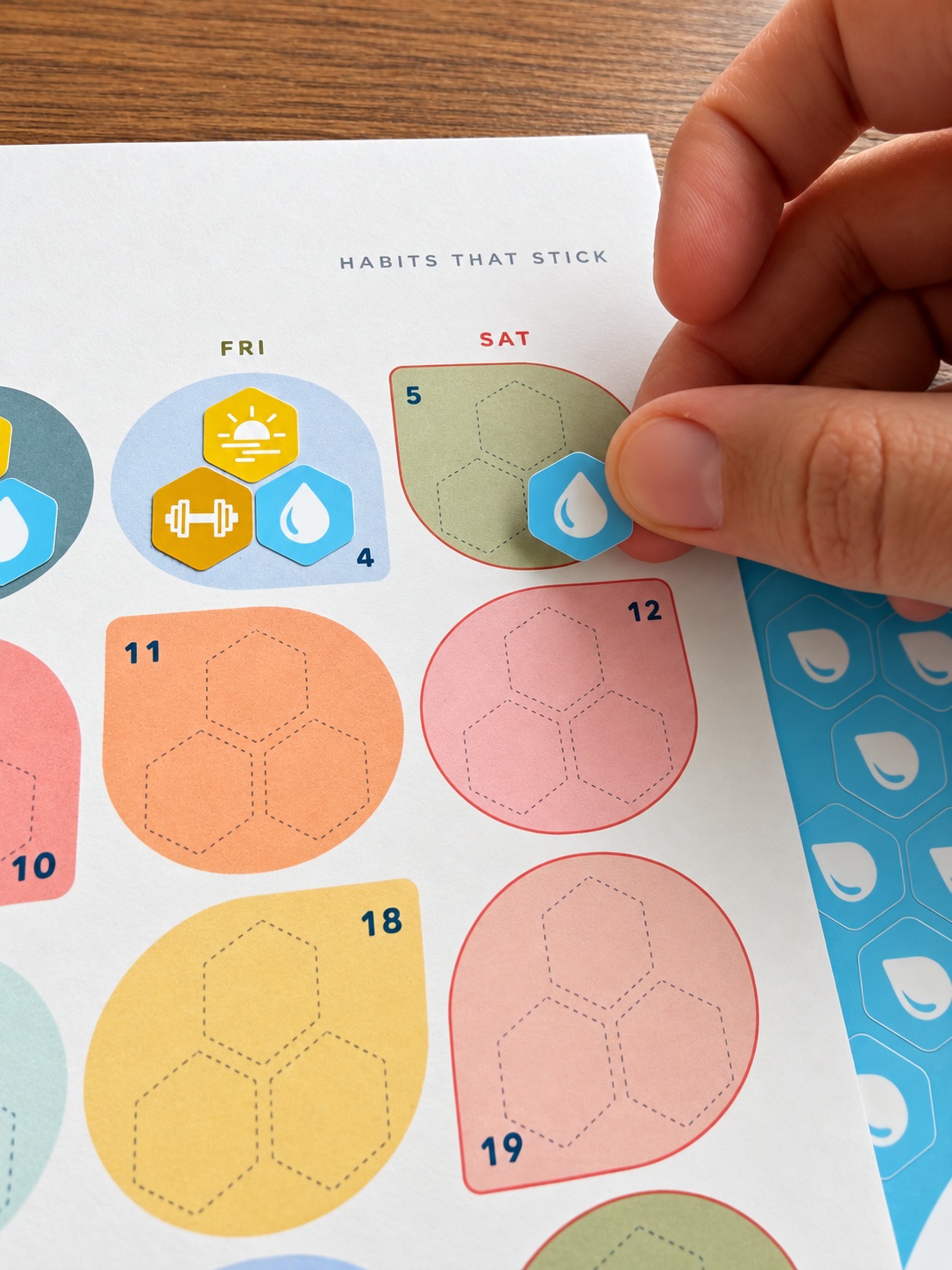
An example of tracking more than one habit with Stickto stickers. Add another when you feel ready.
Printing tips
-
Choose the PDF that matches your paper: A4 (297 × 210 mm) or US Letter (11 × 8.5 in). Both are landscape. Start with actual size / 100%; use “fit to printable area” if your printer clips the edges.
-
Thicker paper or cardstock holds up better on a wall or fridge.
-
Use a marker you like. Some people use a different color each week so they can see patterns.
Want your X's to feel a little more satisfying?
If putting an X on the page helps you keep going, a pen is all you need. If you’d enjoy a small sticker each time you show up, browse Stickto habit stickers or create your own.
I made Stickto because those little marks helped me come back. Use whichever feels good enough to do again tomorrow.
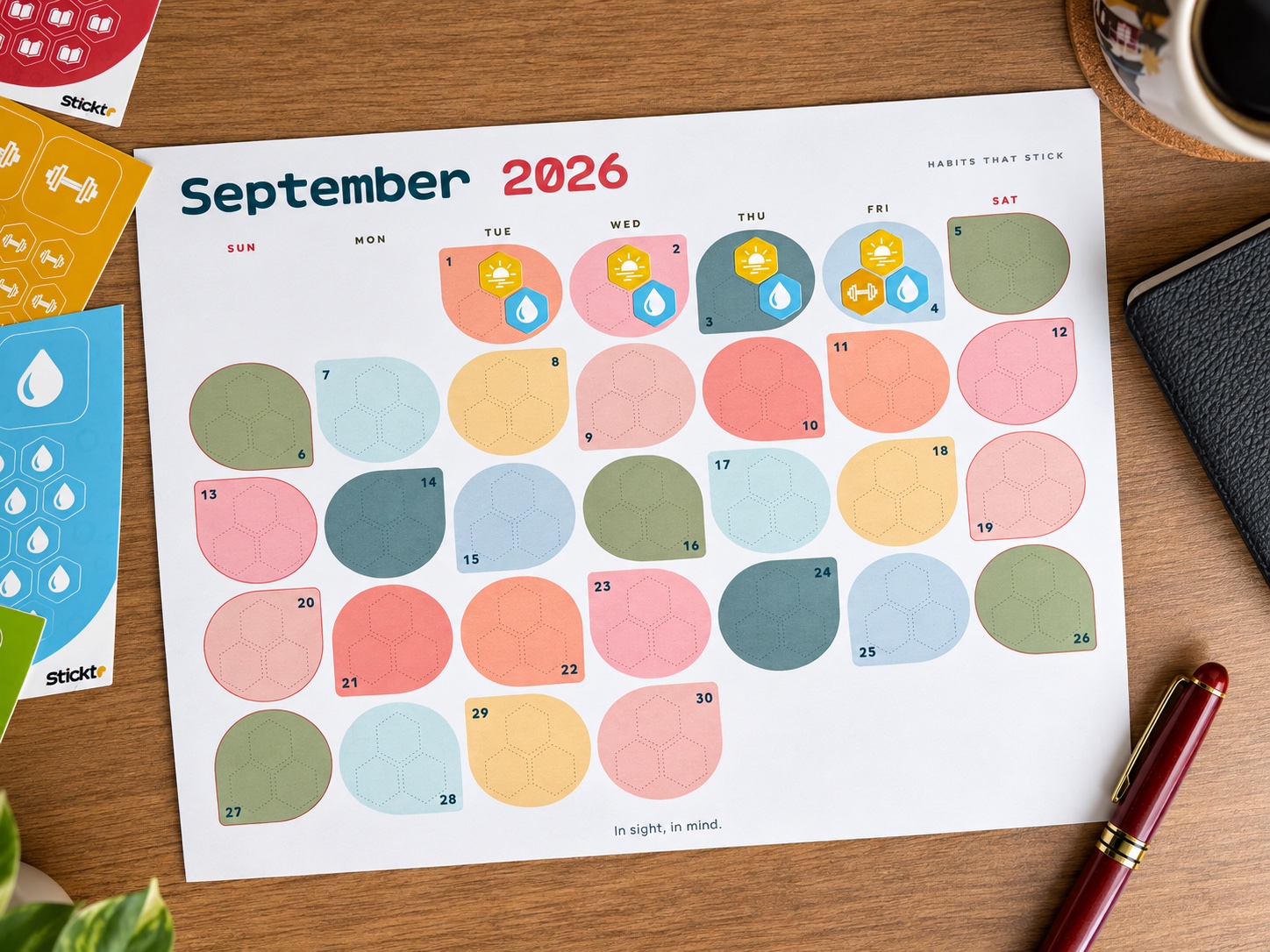
The Stickto sticker calendar, shown here in September 2026. The free November PDF above has its own simpler design.
Keep a fresh page ready.
A new month is another chance to show up for yourself.
Get a free calendar each month
FAQ
Is this printable habit tracker really free?
Yes. The November 2026 calendar is a free, instant download with no sign-up. Print it as many times as you like for personal use.
How do I get next month’s calendar?
Sign up for the free monthly calendar above. I’ll email you a fresh calendar at the start of each month in A4 and US Letter. Stickto updates are a separate, optional choice, and you can unsubscribe anytime.
How many habits should a beginner track?
Start with one. A single habit is easier to remember, easier to fit into your day, and easier to see progress on. I started with five minutes of writing and only added more once it felt normal.
What should I do if I miss a day?
Leave the box blank and mark the next day you do the habit. In Lally et al.'s study, missing one opportunity did not materially affect habit formation, so one gap doesn't mean starting over.
How long does it take for a habit to stick?
It varies. In the UCL study, model-based estimates ranged from 18 to 254 days for reaching 95% of eventual automaticity. Those estimates are not a personal deadline. Focus on repeating a manageable action in a consistent context.
Does tracking a habit on paper actually help?
Monitoring your progress is linked to reaching goals more often. A 2016 meta-analysis of 138 studies found larger effects when progress was physically recorded, and a calendar on the wall is one simple way to do that.
What size is the printable?
Choose A4 (297 × 210 mm) or US Letter (11 × 8.5 in). Each PDF is one page in landscape orientation, sized for that paper.
Sources
-
Harkin, B., Webb, T. L., Chang, B. P. I., Prestwich, A., Conner, M., Kellar, I., Benn, Y., & Sheeran, P. (2016). Does monitoring goal progress promote goal attainment? A meta-analysis of the experimental evidence. Psychological Bulletin, 142(2), 198–229. https://doi.org/10.1037/bul0000025
-
Lally, P., van Jaarsveld, C. H. M., Potts, H. W. W., & Wardle, J. (2010). How are habits formed: Modelling habit formation in the real world. European Journal of Social Psychology, 40(6), 998–1009. https://doi.org/10.1002/ejsp.674
I'm Sam, and I made Stickto. If you want the longer version of how it started, it's on my About page.